

Photo by Tima Miroshnichenko
Digital money, persuasion and fraud are now inseparable. In a Strategic Menu for Credit Unions in 2026, we identified “Help members and families navigate digital money, fraud and financial manipulation” as one of the core strategic priorities for the coming year. We return to that recommendation here because the threat environment continues to intensify and because building member understanding and confidence is not simply a communications task but a foundational capability for the co-operative system. With fraud losses rising on both sides of the border and with account takeovers becoming more organized and scalable, we believe this area warrants sustained focus throughout 2026 as credit unions work to strengthen resilience, trust and financial capability across all membership groups.
The current threat landscape
United States
In late 2025, the U.S. Department of Justice announced the seizure of a domain and a stolen-password database tied to an organized bank account takeover operation. The scheme used fraudulent search ads and look-alike bank websites to harvest credentials, enabling criminals to drain real consumer and small-business accounts. The Department of Justice reported approximately $14.6 million in confirmed losses and $28 million in attempted losses linked to identified victims, and the FBI reports more than 5,000 account takeover complaints in 2025 alone, with losses exceeding $260 million.
The activity reflects a structured, repeatable process that combines paid search advertising, look-alike websites, social engineering and automated credential capture.
Canada
The Canadian government does not yet publish account takeover statistics in the same consolidated way as the U.S. government, but the Canadian Anti-Fraud Centre reports that online banking and identity-based fraud remain among the fastest-growing and most costly categories. Reported fraud losses in Canada exceeded $600 million in 2024, and industry research shows rapid growth in digital account compromise attempts over the past several years, alongside material financial impact on households and businesses.
Across both countries, the data points to increasing use of digital access, impersonation techniques and psychological manipulation in fraud activity, with overall scale and frequency continuing to rise.
Why this matters now
The issue is not only that fraud volumes are rising, but that the methods being used increasingly combine technology with behavioral influence. Urgency cues, trusted brand signals, familiar interfaces and automated processes are being used in ways that blur the line between legitimate and malicious activity. This makes traditional warning signs harder for members to recognize and increases the likelihood of error even among financially experienced users.
For credit unions, the implications extend beyond immediate financial loss. Confidence in digital channels, perceptions of safety and the broader trust relationship with members are central to the co-operative value proposition. When those are tested, the impact is strategic rather than purely operational, affecting how members engage, how they perceive risk and how they judge the institution’s role as a steward of their financial wellbeing.
Who is affected
Fraud is often associated most strongly with older adults, in part because they account for higher average losses. At the same time, working-age adults and younger members are increasingly targeted through digital channels, employment scams, investment fraud, account takeovers and impersonation attacks. In both the United States and Canada, reported cases and losses now span all adult age groups.
Financial literacy as a foundational defence
Alerts and warnings are necessary, but on their own they tend to be episodic and reactive. They are most effective when they are reinforced by a broader financial literacy approach that builds understanding and confidence over time. For credit unions, this means strengthening the baseline of member capability so that people are better equipped to interpret digital cues, question unusual requests and respond thoughtfully before the next scam pattern emerges.
A structured financial literacy program contributes to this by:
Building understanding of everyday financial systems and digital money in practical life contexts
Improving recognition of common scam and identity theft patterns
Normalizing verification and “pause before you act” behaviors
Creating shared financial language across generations, enabling families and communities to discuss risk and decision making with confidence
A focus on financial capability helps develop the everyday judgement and habits that support safer behavior in digital financial environments and more confident responses when something does not look or feel right.
The complementary layer in the defense stack
If financial literacy is the human capability layer that strengthens fraud resilience, the question for credit unions becomes how that capability is delivered at scale, across demographics and channels, in a way that aligns with cooperative values and day-to-day realities.
It’s a Money Thing is a comprehensive, credit-union-branded financial literacy program designed to serve that role. It is delivered online through video, articles and short-form social media, and it is also designed to be taught in person in classrooms, branches, workplaces and community groups.
Its library includes 48 core financial literacy topics, covering everyday personal finance as well as specific modules such as Foiling Identity Theft and How to Spot Scams. Together, these build financial understanding, risk awareness and confidence across age groups.
It’s a Money Thing is designed to complement, not replace, technical fraud and cybersecurity controls. Rather than focusing on network security or authentication systems, its role is to strengthen the human side of financial resilience by building the awareness and confidence that help members question, verify and report before harm occurs.
In a layered defense model, this education layer sits alongside fraud monitoring, authentication controls and cyber security, strengthening the overall system by reducing the likelihood that manipulation succeeds in the first place.
What credit unions should do now: a three-layer strategy
Level 1: Member-centric awareness
Focus on immediate, behavior-shaping guidance that reduces the probability of successful account takeover and impersonation.
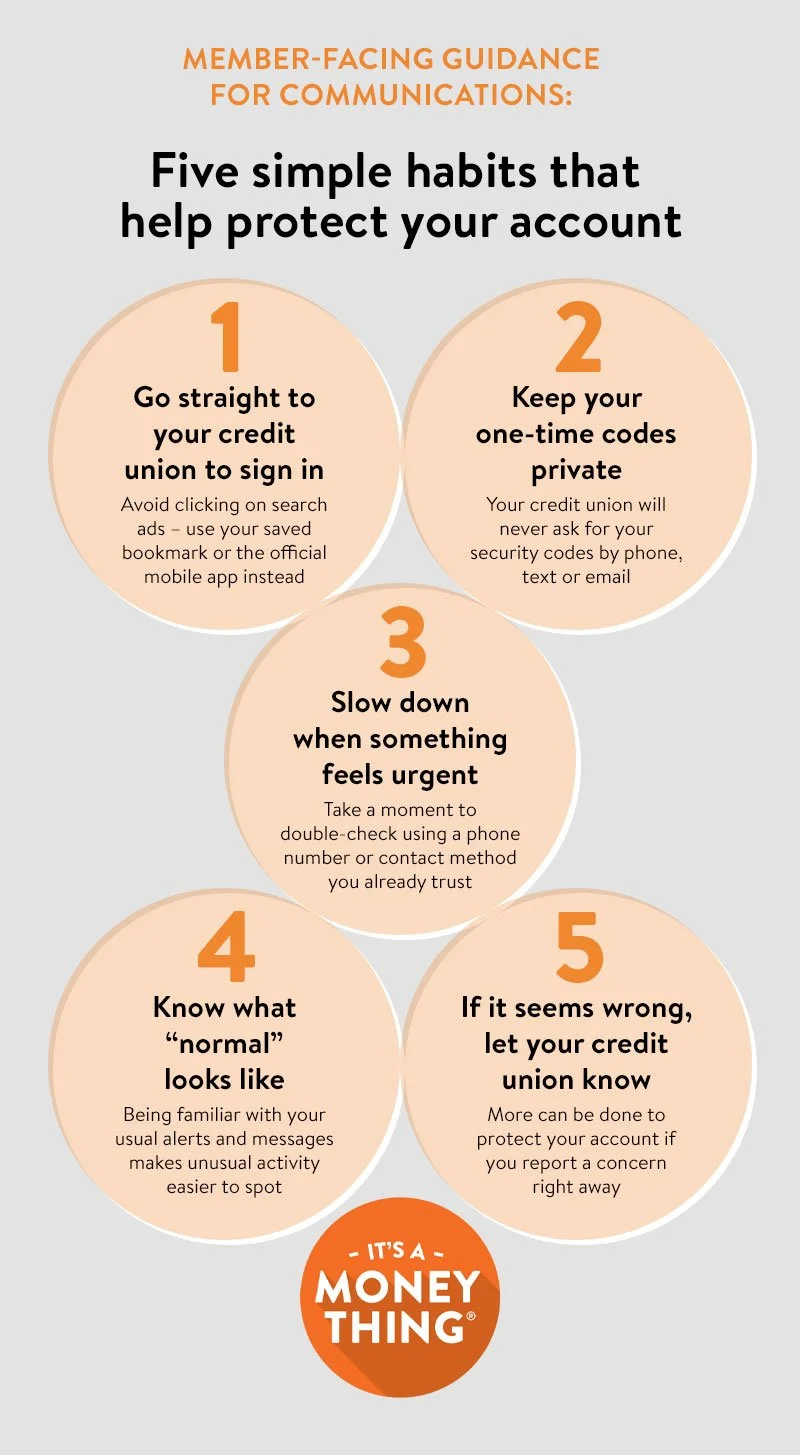
Teach trusted login habits – no credential entry via search ads; use bookmarks or the official app
Promote verification over urgency – normalize pause, call-back and cross-checking before acting
Equip frontline teams with consistent talking points – so members hear the same advice in branch, on the phone and online
Level 2: Normalized financial education
Move beyond alerts and into capability building that becomes part of the member relationship – integrate financial literacy into the member journey
Onboarding, life-stage communications, school and family outreach – use It’s a Money Thing to deliver repeatable, theme-based learning
Scams, identity, digital money, risk and decision making – tailor content by demographic cohort
Youth, working adults, seniors and small business owners
Level 3: Community reach
Extend the role of the credit union from service provider to financial knowledge hub.
Deploy financial literacy in schools and community groups
Partner with employers to broaden exposure
Bring education into branches, events and local forums
Together, these three layers raise the ambient financial IQ of the community. That in turn lowers scam susceptibility, increases early reporting and positions the credit union as a trusted financial educator.
Why delivery model and values matter
Not all financial education solutions are neutral. Some app-centric solutions rely on extensive data collection or are backed by large commercial players whose interests do not always align with the co-operative system. Independent digital safety organizations have raised concerns about data practices and commercial incentives in parts of the ed-tech ecosystem.
For credit unions seeking to position themselves as trusted financial information hubs, this is not a minor issue. Education carries values, assumptions and influence. Who delivers it, how it is funded and how data is handled all affect credibility.
It’s a Money Thing is transparent in purpose, non-extractive in data practice, aligned with co-operative values and designed for both digital distribution and human, community-based delivery. In an environment where technology can easily outpace trust, those characteristics directly shape how members perceive credibility and care. Financial literacy, in this sense, is not just content. It becomes an expression of the credit union brand itself.
A strategic fit for resource constrained credit unions
For smaller, resource-constrained credit unions, a scalable financial literacy program is an unusually efficient strategic lever. It supports fraud awareness, builds member capability and strengthens youth, family and community engagement. It also delivers long-term brand differentiation at a cost far lower than most traditional media or campaign-based approaches, while aligning naturally with co-operative education and community empowerment mandates.
Final thoughts
Account takeovers and digital fraud are scaling because technology, persuasion and money are now tightly intertwined. Education must scale with them.
By pairing strong operational controls with a continuous, values-aligned financial literacy platform such as It’s a Money Thing, credit unions can raise community-wide financial capability, strengthen fraud resilience and reinforce their role as the most trusted source of financial knowledge in the communities they serve.
