
Adding a sixth persona to the credit union marketing playbook

Photo: Ron Lach
CUCollaborate's 2026 Credit Union Marketing Playbook is a welcome contribution to the credit union growth conversation. Built on consumer research and organized around five prospect personas, it offers practical guidance for credit unions seeking to improve member acquisition. The Digital Native, Affluent Achiever, Community Connector, Retirement Planner and Value Seeker each represent distinct audiences with different motivations, barriers and messaging requirements. For institutions looking to sharpen their acquisition strategy, there is considerable value in the framework.

Source: CUCollaborate
At Currency Marketing, we believe there is an opportunity to build upon that foundation. Not because the playbook is wrong, but because the challenge facing many credit unions extends beyond acquiring today's members. The industry is also confronting the question of where tomorrow's members will come from.
The demographic reality is difficult to ignore. Across the U.S. and Canada, credit union members are, on average, significantly older than the general population. Many estimates place the average member roughly a decade older than the average consumer. Consolidation has produced larger institutions and stronger balance sheets in many cases, but it has done little to change the underlying demographic profile of the movement. A larger credit union with an aging membership base still faces an aging membership base.
At the same time, the competitive environment continues to evolve. Fintech firms are attracting younger consumers through convenience, user experience and digital-first engagement. Alternative and predatory lenders remain deeply embedded in many communities despite the costs they impose on borrowers. Banking deserts continue to emerge in both rural and urban markets, leaving many consumers underserved by traditional financial institutions. Newcomers and non-primary English speakers often face additional barriers to accessing mainstream financial services. Layered across all of these challenges is a financial literacy gap that affects roughly half of adults, limiting confidence and participation in the financial system.
Viewed through this lens, member acquisition and member development are not the same thing. CUCollaborate's personas focus primarily on consumers who are already in the market. They are comparing providers, evaluating products and considering where to place their financial business. Those audiences matter enormously, and credit unions should absolutely pursue them. Yet there is another audience that deserves attention because it represents the future health of the movement itself.
The sixth persona: the Future Member
Future Members are high school students learning about money for the first time. They are college and university students navigating debt, budgeting and financial independence. They are young workers entering the workforce, newcomers establishing themselves in a community and families making their first significant financial decisions. Most are not shopping for a mortgage today. Many are not comparing financial institutions at all. Nevertheless, they will eventually become the Digital Natives, Value Seekers and Affluent Achievers described in the playbook.
The question is whether a credit union establishes a relationship with them before someone else does.
This is where financial literacy becomes strategically important. Too often, financial education is treated as community outreach, corporate citizenship or a nice thing to do when budgets allow. Those outcomes matter, but they may undersell its strategic value. Financial education can also be one of the most effective long-term member acquisition strategies available to a credit union.
When a credit union partners with local schools, colleges, community organizations, newcomer-serving agencies and employers, it creates something more durable than a marketing campaign. It builds familiarity, trust and relevance. It demonstrates expertise before a consumer needs a loan, a mortgage or an investment account. It creates positive associations that may persist for years before a financial decision is made.
Importantly, this approach is particularly relevant to the thousands of small and micro credit unions that make up the majority of the movement. Many cannot outspend national banks, fintech firms or larger regional competitors. Few have the marketing budgets required for sustained mass-market acquisition campaigns. What they can do is become the most visible and trusted source of financial education within their communities.
A budgeting workshop in a local high school. A fraud prevention seminar for seniors. Financial wellness programs delivered through local employers. Credit-building sessions for newcomers. Student debt discussions at a community college. None of these initiatives require a national advertising budget. All of them strengthen community relationships while helping create future members.
Seen this way, the addition of a sixth persona does not replace the first five. It complements them. The five personas identified by CUCollaborate help credit unions capture existing demand. The Future Member helps credit unions create future demand. One addresses immediate growth opportunities. The other addresses long-term sustainability.
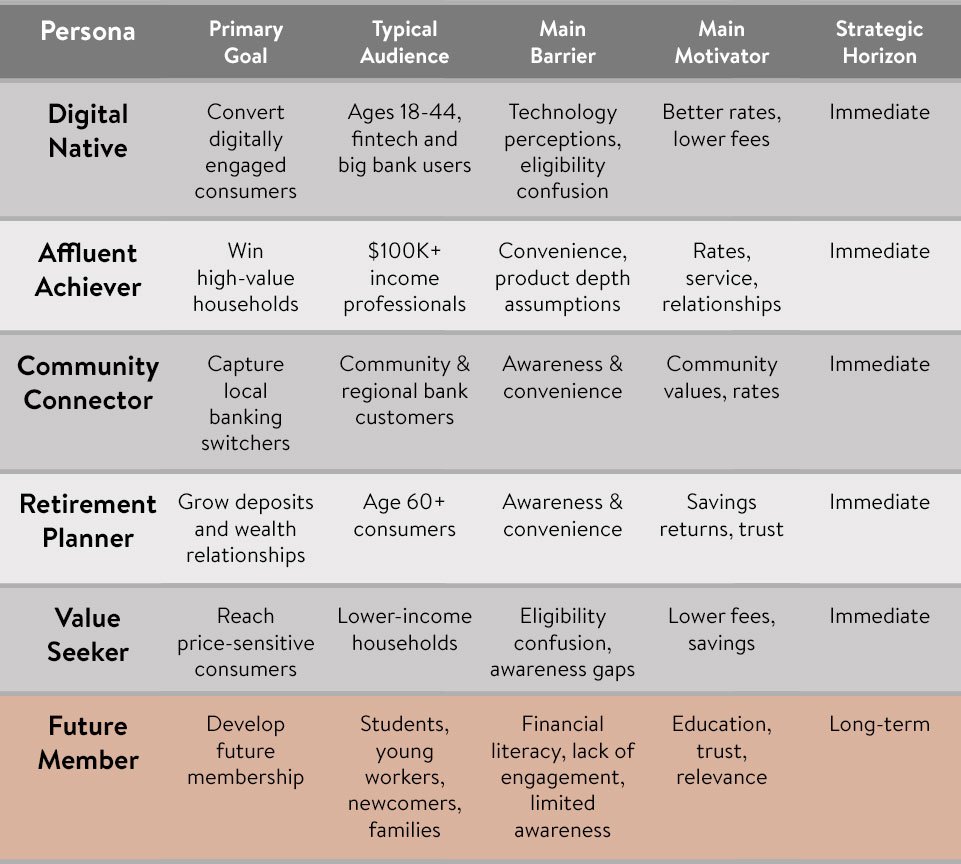
Source: CUCollaborate
The strongest credit union growth strategy may not be choosing between the two approaches. It may be combining them. By pairing effective member acquisition with active leadership in financial literacy, credit unions can address today's growth objectives while building the next generation of members. In doing so, they expand not only their own reach but also the relevance and resilience of the cooperative financial system itself.
More than 100 credit unions already use It's a Money Thing from Currency Marketing to deliver financial education in their communities.
