
Financial literacy in the age of AI: why critical thinking is becoming a core safety skill

Photo by Google Deepmind
Artificial intelligence has moved quickly from novelty to infrastructure. Large language models now answer questions, summarize information, draft documents and increasingly influence decisions in business, government, education and everyday life. Just as importantly, people are already using them to ask practical questions about money: budgeting, debt, credit scores, investing and retirement.
This is why AI safety has entered the mainstream policy conversation. In the United States, America’s Credit Unions has called for a balanced and flexible approach to AI that protects consumers while enabling innovation, noting both the opportunities and the risks these technologies create for members. The National Credit Union Administration now includes AI within its compliance and risk guidance, particularly around data integrity, fraud and the safe use of automated systems. Several states are also introducing rules governing automated decision making that will affect underwriting, marketing and fraud detection.
In Canada, a similar shift is underway. The Financial Consumer Agency of Canada has convened industry, regulators and consumer advocates to examine AI through the lens of consumer protection and financial well-being. Federal public awareness initiatives on responsible artificial intelligence explicitly identify AI literacy as a critical capability, emphasizing the need for people to be able to critically evaluate automated systems. With legislation such as the proposed Artificial Intelligence and Data Act, Canada is also moving toward a more formal governance framework for AI in sectors that include financial services.
The signal from both countries is clear. AI is no longer just a technology topic. It is a consumer protection and financial capability issue.
A recent Visual Capitalist analysis helps make this issue concrete.
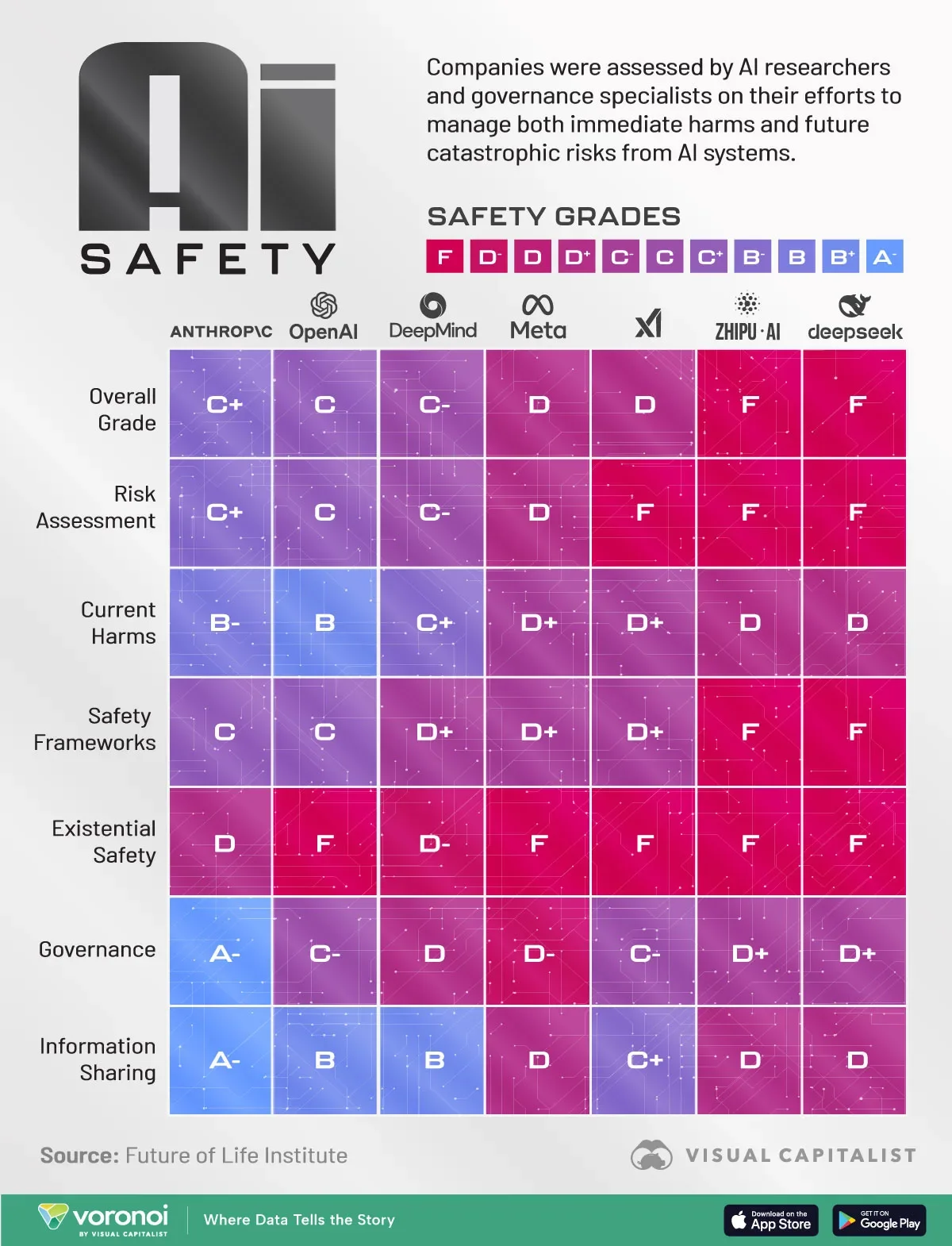
Source: Future of Life Institute and Visual Capitalist
A recent infographic from Visual Capitalist, based on the Future of Life Institute’s AI Safety Index, reinforces this. It evaluates leading AI developers on governance, transparency and risk management. The key takeaway is that even the most advanced technology companies are still early in building mature and consistent safety frameworks. In practical terms, this means that systems people already trust for information and advice are being developed in an environment where safety standards are still evolving.
This matters because members are not waiting for standards to mature. Like social media before it, AI has become a first stop for answers. People are already treating large language models as a source of financial guidance. The pattern is familiar. The information can be useful, but it is generalized, unregulated and not accountable. Confidence of delivery can easily be mistaken for quality of advice.
The core risk is not technical, it is cognitive
Much of the concern in AI safety centers on over-trust, difficulty judging reliability, weak source evaluation and the tendency to accept fluent answers without testing assumptions or incentives. These are the same vulnerabilities that financial literacy education has always been designed to address.
At its foundation, financial literacy is about how to think, not just what to know. It develops the ability to evaluate claims, understand risk and uncertainty, question sources, recognize conflicts of interest and know when general information is not a substitute for personal, qualified advice. These are precisely the skills required when financial decisions are increasingly mediated by automated systems.
A timely and legitimate role for credit unions to step forward
Regulators and national associations are acknowledging that AI now affects consumer outcomes. Members are already using these tools. Public policy is beginning to frame AI literacy as a basic life skill. For credit unions that position themselves as trusted guides and counselors, this is a natural moment to engage with clear, practical education.
Issuing simple AI advisories and pairing them with financial literacy programming is not about fear or technology hype. It is about reinforcing sound judgment. It is about reminding members how to evaluate information, when to verify and when to seek qualified human support.
This is where programs such as It’s a Money Thing are particularly relevant.
It’s a Money Thing operates in both digital and in-person environments. It lives online, but it is also delivered in classrooms, community settings and face-to-face conversations. That combination matters. In a world where more guidance, more interaction and more influence are mediated by screens and algorithms, human context still plays a critical role in learning. Discussion, questioning and shared experience help people develop judgment, not just absorb information.
In practical terms, this means financial literacy is not only content. It is a social and cognitive process. It builds confidence to ask questions, to challenge answers and to seek trusted advice rather than defaulting to automated sources.
There is also a strategic dimension for credit unions
Large language models are rapidly becoming a new discovery channel for financial questions, much as search engines and social platforms once were. Ensuring that accurate, unbiased and member-first educational content is present and visible in this emerging environment will become part of the modern marketing and trust-building toolkit. Financial literacy content is not only a public service. It is also a way to ensure that the co-operative voice is represented where members increasingly look for guidance.
The Visual Capitalist safety scorecard reminds us that even the creators of AI are still learning how to manage its risks. That reality reinforces the enduring value of human judgment.
In an economy increasingly shaped by automated systems, the most valuable role a credit union can play is to help members think clearly, evaluate information critically and know when to rely on qualified human expertise. Financial literacy, supported by programs like It’s a Money Thing, becomes a modern expression of the co-operative promise: education before sales, protection before profit and people before automation.
