
From dream jobs to real incomes: what the next generation is actually facing

Photo by Kindel Media
Ask a child what they want to be, and the answers are remarkably consistent across generations. Firefighter, doctor, nurse, police officer, astronaut or professional athlete. For older Gen Z and now Gen Alpha and emerging Gen Beta, the list has expanded to include YouTuber, influencer or game developer, but the underlying pattern has not changed. These are visible roles, easy to understand and closely tied to identity as much as income.
The labor market those same children will enter tells a very different story. The pathways into adulthood are less linear, less visible and increasingly shaped by forces that sit well beyond any single profession.
What young people actually do
For most school leavers and graduates in 2026, career outcomes are far more concentrated than early aspirations suggest. Across the United States and Canada, early roles tend to cluster in sales, administration, service industries, healthcare support, skilled trades and junior positions across business functions such as marketing, finance and technology. Increasingly, they also include contract work, platform-based income and hybrid roles that did not exist even a few years ago.
Income reflects this reality. Entry-level earnings typically range from approximately $35,000 to $60,000 depending on sector, with some technical and financial roles pushing higher and trades often outperforming early as experience builds. These are stable and necessary roles, but they are a long way from the professions most people imagined in childhood.
That gap between aspiration and outcome has always existed. What is different now is the level of uncertainty layered on top of it.
A labor market in transition
Graduates of 2027 and 2028 are entering a workforce being reshaped in real time by artificial intelligence. Large employers are adjusting hiring plans and workforce structures as automation improves efficiency and reduces the need for certain types of entry-level work. Recent moves by firms such as Oracle, Amazon and Meta reflect a broader recalibration rather than isolated events.
The effect is not the elimination of work, but its compression. Tasks that once required teams are increasingly handled by individuals supported by software. Roles built around repetition or process are under pressure, while work that depends on judgement, physical skill or human interaction is being revalued. Skilled trades, healthcare and technical roles that build or supervise AI systems are increasingly viewed as more resilient, while career paths themselves are becoming less fixed over time.
The inheritance assumption
Alongside changing career prospects sits another widely held belief: that younger generations will inherit significant wealth. In both Canada and the United States, trillions of dollars are expected to transfer from older generations over the coming decades, creating an assumption that Gen Alpha and Gen Beta will benefit from a substantial financial tailwind.
That assumption is becoming less certain. Longer life expectancy, rising healthcare costs, extended retirement periods and housing pressures are steadily drawing down accumulated wealth. In many cases, assets that might once have been passed on are now being used to support longer and more complex later-life needs.
For younger generations, this introduces a different reality. The expectation of inheritance is being replaced by a greater reliance on earned income and individual financial decision-making.
A different starting point for what comes next
The cohort that follows Gen Beta, often referred to as Generation Gamma, will enter a fully AI-integrated economy from the outset. They will not experience a transition into this environment. They will begin within it, where automation, digital systems and hybrid work structures are already embedded in everyday life.
In that context, the idea of a single, stable career becomes less likely. Working life is expected to involve multiple roles, evolving skill sets and shifting income sources over time. That has implications not only for employment, but for how individuals think about money, risk and long-term planning.
Financial capability under pressure
Across all of these changes, one factor has remained largely unchanged. Financial literacy levels in both the United States and Canada continue to sit at roughly 50%, a figure that has shown little movement over the past decade despite a significant increase in financial complexity.
Consumers are now navigating a landscape that includes traditional banking, fintech platforms, app-based financial services, buy-now-pay-later products and self-directed investing. Cryptocurrency adds another layer, often without the safeguards people associate with insured deposits or regulated institutions. The pace of innovation is now outstripping the pace at which most people develop the capability to manage it.
The expansion of digital financial tools was expected to improve outcomes. App-based banking, budgeting tools and investment platforms made financial activity easier and more accessible. By that logic, financial literacy should have improved alongside adoption. It has not. Greater access has reduced friction, but it has not materially improved understanding, and in some cases has simply increased the speed of poor decisions.
Artificial intelligence is now being layered onto that same environment. While it has the potential to simplify complexity, it is also contributing to an already crowded information landscape, where credible guidance competes with confident but unverified advice.
Platforms such as TikTok and YouTube are filled with “finfluencers” offering advice on investing, debt and wealth-building, often with large audiences but limited formal qualifications. Regulators, including the U.S. Securities and Exchange Commission and the Canadian Securities Administrators, have begun to respond, but enforcement remains uneven relative to the scale of content being produced.
The result is an environment where access to information is no longer the constraint. The constraint is the ability to evaluate it. At the same time, there is growing demand for more direct, more human forms of engagement. Classroom-based and facilitated learning are not a step backward. They are a necessary complement to digital tools, providing the context and judgement that technology alone has not delivered.
Housing and the reality of wealth creation
The scale of that challenge becomes clearer when viewed through housing. In the United States, saving for a down payment now stretches well beyond a decade on average, with timelines extending past 20 years in higher-cost states.
Canada tells a similar, and in many cases more demanding, story. While national averages suggest timelines closer to five to ten years, those figures quickly extend in larger provinces and major urban centres. In markets such as British Columbia and Ontario, and particularly in cities like Vancouver and Toronto, the time required to save for a home can approach or exceed the length of early career progression itself.
The differences across regions are significant. The following comparison outlines how long it takes to save for a home across both U.S. states and Canadian provinces, highlighting how much the timeline has shifted from what previous generations experienced.
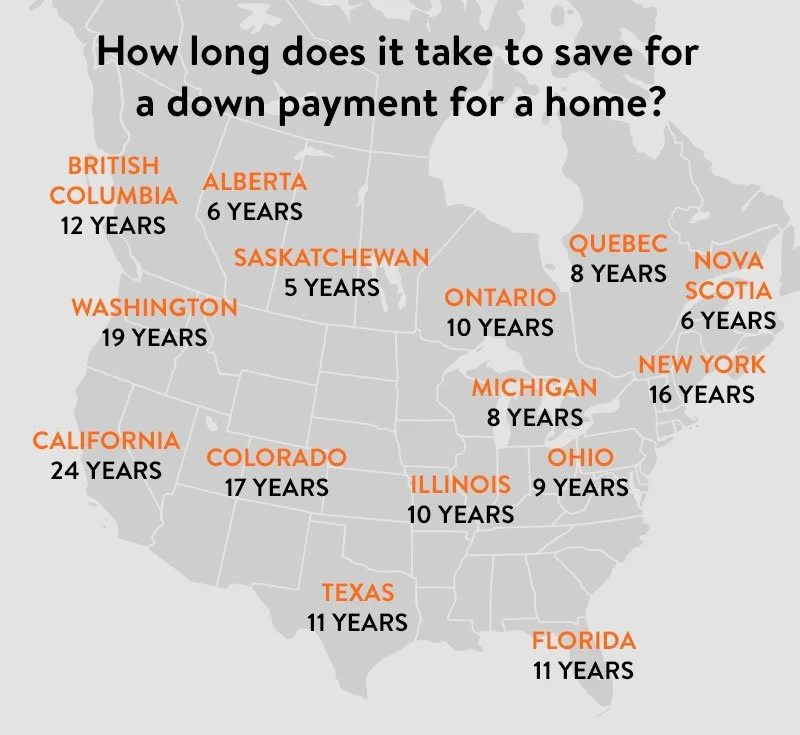
What was once considered an early milestone in adulthood has become a long-duration financial objective, often competing with rising rents, slower income growth and the need to take on debt simply to enter the market.
Where this leaves the next generation
The traditional model of adulthood was built on predictability, where stable employment led to steady income and gradual wealth accumulation over time. That model is weakening, replaced by a more variable system in which careers shift, income moves and financial decisions carry greater long-term consequence.
Financial literacy does not remove that uncertainty, but it plays a central role in determining how individuals navigate it. In an environment defined by change, it becomes the mechanism through which stability is created rather than assumed.
The role for credit unions
For credit unions, these shifts are already visible in member behavior and financial outcomes. Younger individuals are entering the system with more complex choices, less predictable income paths and greater exposure to digital financial tools. At the same time, employers are increasingly acting as informal financial coaches, responding to employee demand for guidance on debt, savings and financial stress.
This creates an opportunity to engage earlier and more meaningfully within communities. Financial education delivered through schools, workplaces and local organizations allows credit unions to build relevance at the point where financial habits are first forming. Programs that combine digital accessibility with in-person discussion align closely with how people are now choosing to learn, pairing reach with the interaction required to build understanding and confidence.
The underlying constant
Children will continue to imagine adulthood in simple, visible terms, while the reality they step into becomes more complex and less predictable. Careers are less certain, income is less linear and assumptions about future wealth are increasingly unreliable.
In that environment, financial capability is no longer a secondary skill. It is foundational, shaping how individuals manage risk, make decisions and build stability over time.
