
Consolidation solves some problems, but not all of them

Roger Staubach, the thrower of the game-winning touchdown pass to wide receiver Drew Pearson during an NFL playoff game between the Dallas Cowboys and the Minnesota Vikings on December 28, 1975. Source: Wikimedia
Consolidation has become one of the defining realities of credit union systems in the United States and Canada. In many cases, the logic is understandable. Technology costs continue rising. Compliance obligations continue rising. Fraud risks continue rising. Consumers increasingly expect sophisticated digital experiences regardless of institution size.
But I increasingly wonder whether some institutions are solving operational problems while leaving the larger strategic problem untouched.
Credit unions were originally built around community familiarity and trust. In Canada, Alphonse Desjardins helped establish the caisse populaire movement in Quebec in 1900. In the United States, Edward Filene and Roy Bergengren helped expand the co-operative model through factories, churches, unions and farming communities. Members often shared geography, occupation or social ties. The institution was expected to know the people it served because it existed inside the same community.
A foundation that still matters
Small and micro credit unions, which largely resemble the original shape of the movement itself, still make up most credit unions across the United States and Canada. Yet many now face intense pressure from consolidation, fintech competition, staffing shortages and changing member expectations.
And to be fair, some mergers absolutely make sense. Larger institutions can spread costs more effectively and modernize infrastructure more easily. But scale alone may not solve the deeper issue many institutions are now facing: declining emotional relevance.
Consumers increasingly experience financial institutions as utilities accessed through screens. Many younger consumers struggle to distinguish one institution from another beyond app functionality. Meanwhile, people live inside increasingly impersonal environments filled with AI-generated content, automated customer service and constant digital advertising.
Against that backdrop, small credit unions may still possess something valuable: familiarity, trust and local relevance.
A thought experiment to clarify the issue
Source: LinkedIn
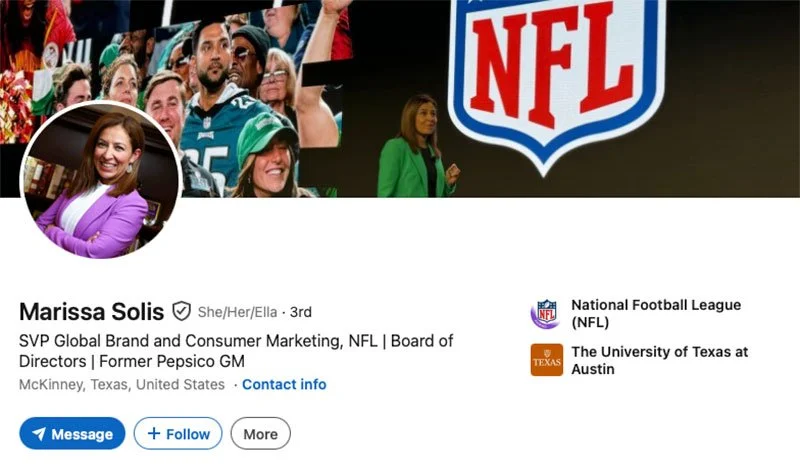
Suppose somebody like Marissa Solis suddenly became CEO of a small urban credit union. Solis is currently Senior Vice President of Global Brand and Consumer Marketing at the NFL and recipient of the American Marketing Association’s Lifetime Achievement Award. Earlier in her career, she worked at Procter & Gamble, one of the most disciplined brand-management environments in the world.
Marketers from that environment are usually trained not to begin with tactics. They begin with diagnosis.
That discipline traces back to the famous McElroy Memo written at Procter & Gamble in 1931. Its logic still underpins much modern marketing strategy today: understand the customer, understand the competition, understand the market, then decide what problem you are actually trying to solve before rushing into execution.
I doubt Solis would immediately try to make the credit union appear bigger or more corporate. In fact, she might view that instinct as part of the problem. Many organizations respond to pressure by slowly imitating larger competitors until eventually everybody sounds the same.
I suspect she would diagnose something deeper. A loss of visibility in everyday community life. A weakening connection to younger households. And an overreliance on passive digital communication that technically exists but rarely leaves much impression on anybody.
That diagnosis would likely lead her toward a very different strategy than most people expect. Not louder advertising. Not chasing viral social campaigns. Or trying to out-fintech fintech firms.
Community outreach would probably become the strategic battlefield. More specifically, structured financial education delivered directly into schools and community environments where trust and familiarity can still be built consistently over time. That matters because classroom-based financial education behaves very differently from digital marketing.
Students can ignore banner ads and scroll past social posts in seconds. Most young people are not actively searching for financial education content in the first place. They are competing against entertainment systems engineered by some of the smartest attention designers in the world. Optional financial education almost always loses that battle.
Classroom participation changes the equation
Once financial education enters structured educational environments, it stops behaving like content marketing and starts behaving more like community infrastructure. Students participate. Teachers facilitate discussion. Parents become aware of the institution involved. Communities notice which organizations are showing up consistently and constructively inside schools.
Where the strategy and the tactics begin aligning
A program like Currency Marketing's It's a Money Thing becomes more than educational content. It becomes a practical outreach vehicle for small institutions trying to build awareness and future consideration among younger households. The same material can support classroom presentations, school partnerships, workshops, website content, email communication and social media simultaneously.
Importantly, the attention being earned is different from traditional advertising attention. It is slower, quieter and probably more durable.
A middle-school student attending a financial literacy class today may become a future member years later. Potential employees may remember the institution positively. Teachers and parents begin associating the credit union with guidance and integrity. That is not immediate lead generation. But it is long-horizon relationship building.
For small credit unions, the economics matter
These institutions are never going to dominate national advertising markets. They are not going to outspend major banks or fintech firms on digital media buying. But they can still become familiar within local environments. They can still become associated with trust, visibility and practical usefulness.
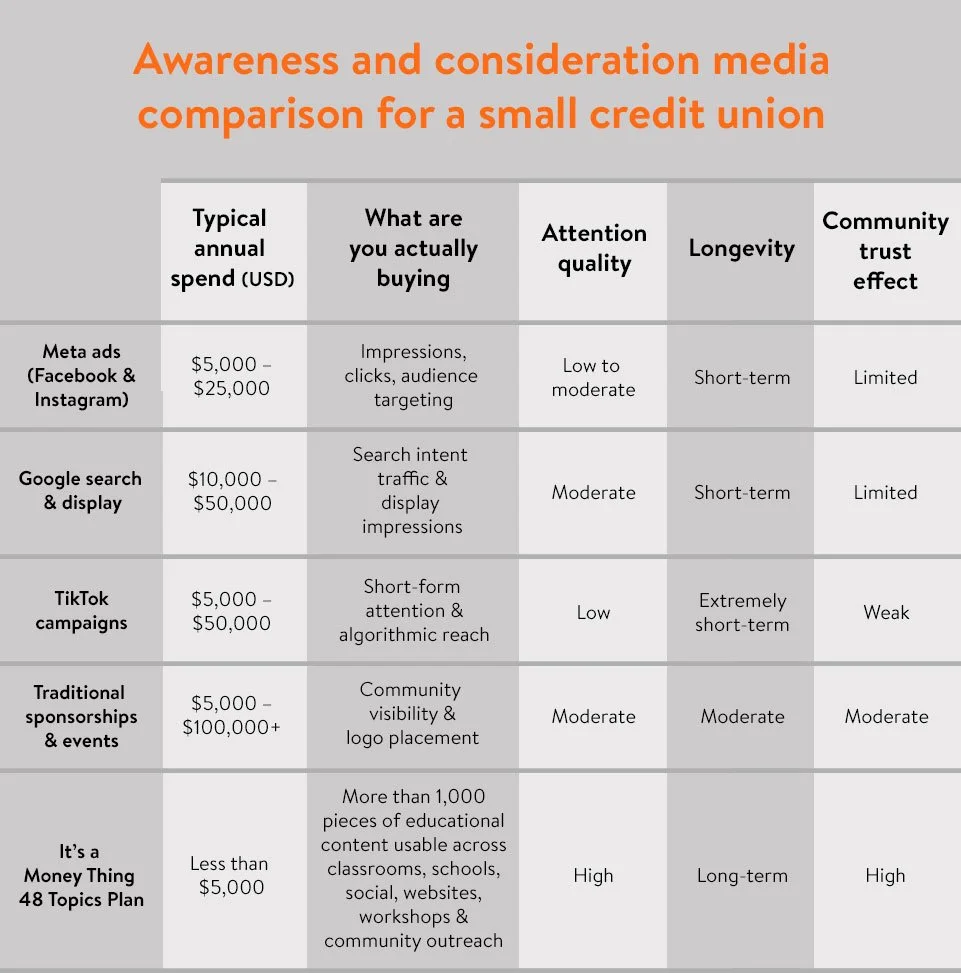
Compared with many awareness media options, classroom-based financial education also carries a surprisingly practical ROI profile.
Awareness and consideration media comparison for a small credit union
Source: CUCollaborate
The comparison becomes interesting when viewed through the lens of small credit union economics rather than pure media buying. Meta, Google and TikTok campaigns are largely interruption-based systems. A credit union is paying to briefly enter a consumer’s attention stream alongside thousands of competing commercial messages. Once the spending stops, the visibility largely disappears as well.
A system like It’s a Money Thing operates differently. The same content library can simultaneously support classroom presentations, school partnerships, social media, website education hubs, workshops, email communication and community outreach. In effect, a small institution gains an educational infrastructure rather than a temporary advertising campaign.
Most small credit unions are not realistically going to build a 48-topic multimedia financial education system internally. By the time scripting, production, editing and curriculum development are accounted for, the costs become enormous very quickly. The economics become even more interesting when a small institution can access the system for less than many organizations now spend testing a single short-lived social campaign.

A recent example appeared in our It's a Money Thing Backstage interview series featuring Tom Schlund of Lutheran Federal Credit Union in St. Louis. Tom described how Lutheran launched “Financial Education Fridays” using It’s a Money Thing as part of a broader initiative aimed at strengthening member engagement and community visibility.
What stood out was not flashy marketing. It was consistency. Weekly educational content. School ambitions. Website integration. Community alignment. A visible attempt to become useful and recognizable beyond simply offering loans and accounts.
Importantly, the initiative did not appear positioned internally as “content production.” It appeared positioned as service.
That distinction may become increasingly important over the next decade.
Because small credit unions are unlikely to win scale wars against trillion-dollar financial institutions. But they may still win something else entirely: trust, familiarity and human relevance in an increasingly impersonal financial system.
