
Back to school, back to basics
As students prepare to return to classrooms this fall, educators find themselves revisiting an old question.
For much of the past decade, conversations in education have centred on technology. Digital devices and tools; all via screens. More recently, artificial intelligence has dominated discussion about the future of education and work. But some of the most interesting developments have been moving in the opposite direction.
In Sweden, policymakers are investing once again in printed textbooks, handwriting and traditional learning methods after concerns that an overly digital approach may have weakened reading and comprehension skills. At the same time, several high-profile graduation speeches promoting the promise of artificial intelligence have generated criticism from students worried about affordability, employment prospects and economic uncertainty.

Ex-Google CEO Gets Booed While Discussing AI in Commencement Speech.
Source: WSJ YouTube Channel
Different issues. But a similar message. Technology can support learning, but it cannot replace the foundational skills that make learning possible: reading, writing, critical thinking and problem solving.
And increasingly, financial literacy
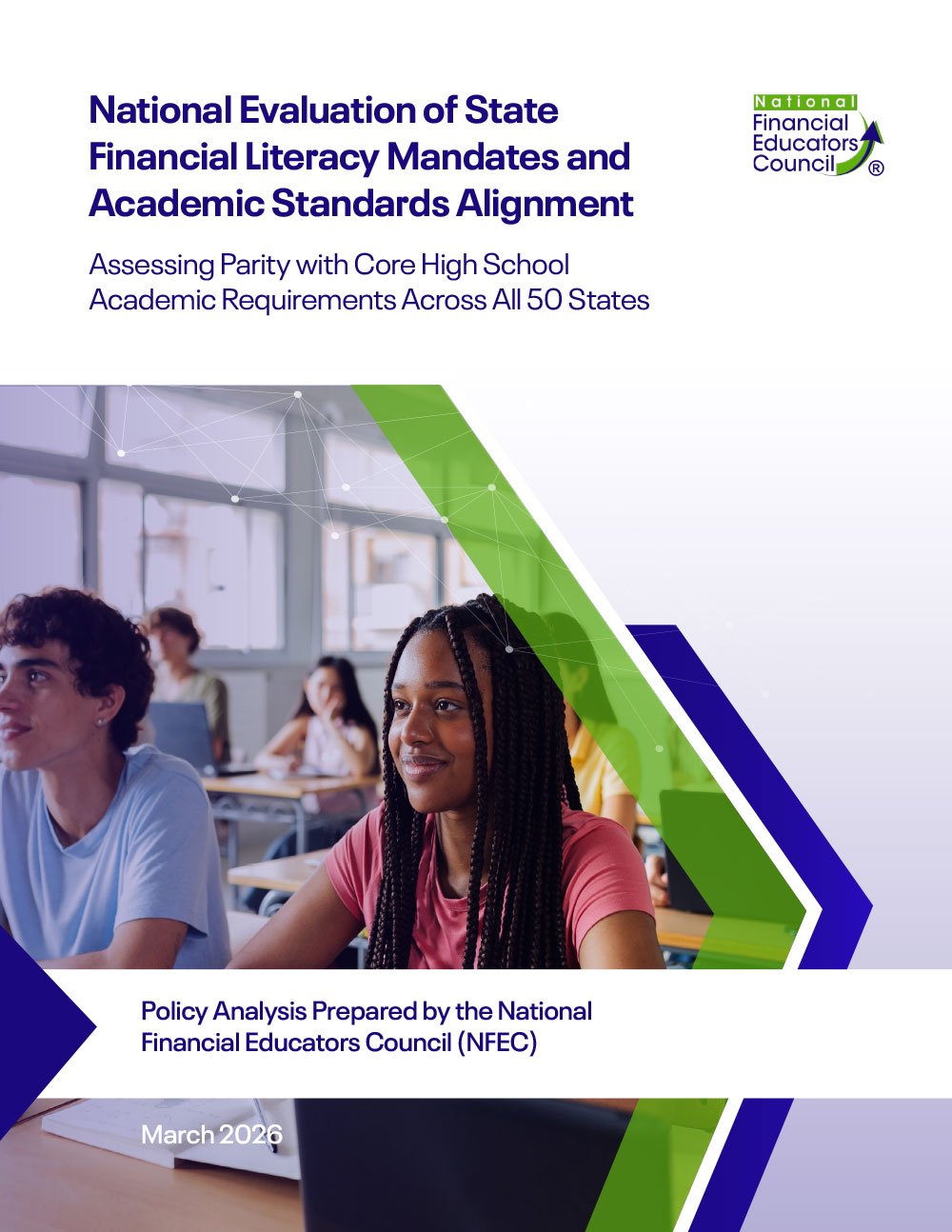
The importance of financial education is now widely accepted. Across Canada and the U.S., governments, school systems, financial institutions and community organizations have invested considerable effort in improving financial capability among young people. Yet a new report from the National Financial Educators Council suggests that recognition and implementation may be two very different things.
The organization recently evaluated financial literacy requirements across all 50 U.S. states against the same standards routinely applied to core academic subjects such as mathematics and English. Rather than asking whether financial literacy is taught, researchers examined whether it is supported with the same instructional rigor, accountability, educator preparation and program infrastructure expected elsewhere in the curriculum.
The report card
No state achieved program-level parity with minimum academic standards. The highest-scoring state earned just 16.7 percent of the maximum possible score. The national average was 3.92 percent. Across 600 evaluated criteria, only two met minimum parity expectations.
Measured against the standards routinely applied to subjects such as mathematics, science and English, financial literacy would be receiving a failing grade in most jurisdictions.
The findings may be American, but the underlying issues are familiar on both sides of the border. Canada has taken a different approach. Rather than focusing primarily on graduation mandates, policymakers have invested in national strategies, research, partnerships and public awareness initiatives. The Financial Consumer Agency of Canada has spent years promoting financial literacy as a contributor to financial resilience and overall well-being.
Yet many of the same challenges persist. Financial confidence often lags behind financial knowledge, while young adults continue to navigate increasingly complex decisions involving credit, housing, student debt, fraud, investing and digital financial services. The need for financial capability has not diminished. If anything, it has become more urgent.
The broader lesson is not that financial literacy has been ignored. Across North America, awareness of the issue has never been higher. The lesson is that recognition and implementation are not the same thing. Introducing a requirement, adding a curriculum outcome or creating a policy framework does not automatically produce financially capable graduates.
That requires something more: consistent instruction, meaningful engagement, practical application and reinforcement over time.
Financial capability is built, not assigned
Mandates matter. Curriculum matters. But lasting financial capability is built through repetition, reinforcement and real-world application. Students do not become financially confident because they sit through a lesson. They become financially confident when concepts are applied, discussed and revisited over time.
The opportunity for credit unions
For generations, credit unions have positioned themselves as trusted financial partners within their communities. Financial education aligns naturally with that mission. It is not a marketing campaign. It is not a product strategy. It is a practical expression of the co-operative principles that have always distinguished credit unions from other financial institutions.
More importantly, credit unions are uniquely positioned to support financial education in ways that schools often cannot. Schools face competing priorities, limited instructional time and resource constraints. Parents are not always comfortable teaching financial topics themselves, and governments can create mandates without necessarily providing ongoing support. That creates space for trusted, community-based institutions to reinforce learning beyond the classroom.
Credit unions operate at the community level. They can partner with educators, support families, provide real-world context and reinforce learning beyond the classroom. They can help transform financial literacy from an isolated lesson into an ongoing conversation.
This is particularly important for smaller and mid-sized credit unions. Most operate with finite marketing budgets and limited visibility compared with larger financial institutions. Financial education offers something increasingly difficult to achieve through traditional advertising: relevance. When a credit union helps young people navigate their first bank account, first paycheck, first budget or first credit decision, it creates value long before a product sale is ever contemplated.
Programs such as It's a Money Thing demonstrate that this work does not require institutions to start from scratch. High-quality, classroom-ready resources already exist. The challenge is no longer creating content. The challenge is building partnerships that place effective financial education in front of the people who need it most.
As another school year begins
The discussion around education is likely to remain focused on technology, artificial intelligence and the changing nature of work. But if Sweden's return to books tells us anything, it is that progress does not always mean abandoning fundamentals. Sometimes it means rediscovering them. Financial literacy belongs in that category. The future may look different than anyone expects, but young people will still need to understand money.
